

Beginners forget this far too often.
6 min read
Context.
Literally, that’s it.
Your copywriting samples are missing context.
I could spend 1000 words writing stats and over-explaining it.
But I won’t.
Instead, I’ll share how to add context to your copywriting samples and some examples of what it looks like in my own portfolio.
But first, let’s get a quick term out of the way that can confuse people…
What Do I Mean By Context?
Context, by definition, is the information that precedes something. It provides the background in which a piece of copy was written — so it explains WHY it was written in the first place.
To explain it another way, think of it like this. Your piece of copywriting is the actor and the context is the stage it’s performing on. Get it?

An actor wandering the street by herself in costume wouldn’t make much sense without knowing the play, the character, or the setting. And the same is true of your work in a copywriting portfolio.
So, how do you set the stage?
Well, I’m so glad you asked!
How to Add Context to Your Copywriting Portfolio
When you’re creating a copywriting sample, far too often beginners just write an ad, an email, or a blog — and that’s it. But they completely leave out any context behind it.
What industry is this for? What type of copy is it? Who are you speaking to? Why did you write it? Where are they going after this? What do they already know about your product?
I have so many questions I don’t even know where to start.

Some relevant information to include is the audience, the brand, the goal, the audience’s level of awareness, the type of copywriting, and its performance.
So, here’s a quick list of what to include so your copy makes sense to anyone reading it…
Elements of a Great Copywriting Sample
You wanna land copywriting gigs, right? Well, stop making basic mistakes and start creating portfolio samples that show you actually know what you’re doing.
With the following, your pitch is just gonna get tossed aside:
- Perfect Grammar & Spelling: I hate to include this, but I constantly catch basic writing errors in portfolios. Unless you’re using slang on purpose (which you should specify!) please run your copy through Grammarly or Hemingway App.
- Headlines & Subheadlines: Break up your text with headlines! I see so many bad samples with huge chunks and no headlines, which for long-form copy like a sales page is a huge red flag.
- Clear CTAs: Too often I see portfolio samples where folks write a CTA without saying if it’s a button, hyperlink, or other clickable element and I have to assume there isn’t a CTA or it just isn’t labelled. Both of which tell me you’re a novice writer.
- Audience: Who was this for? What stage of the customer journey are they on? How aware of the brand? What are they supposed to do next? That makes a big difference in how you write any piece of copy.
- Brand or Niche: If you don’t have permission to share the brand name (like if you signed an NDA) or want to remove it for whatever reason, then you can write the niche instead.
- Goal: What was the purpose behind the copy? Brand awareness, engagement, comments, likes, shares, sales, leads, views?
- Performance Metrics: This one can be tricky, but if you have access to how it performed, definitely include this! For an email, it might be the open rate, for an ad use the click-through rate, for a sales page use the conversion rate, and so on.
A quick note on that last point…
If you don’t know how your copy performed — please don’t just lie. You’re just setting yourself up for failure later on. As a beginner, clients probably won’t tell you (maybe because even they don’t know sadly).
So you can leave that out, but you can still share comments from clients or testimonials about working with you on that specific project instead. That shows that, hey, while you don’t know how the copy performed, at least you can show you’re easy to work with.
Pro Tip: A lot of this contextual information actually comes from your marketing brief! If you have one, you can pull information from there.
As a beginner, you might not use much of a brief with your clients. That’s normal, and I was once a beginner too who overly relied on clients to provide the necessary information. However, if you ever work in-house or at an agency, you’ll see what a huge difference a proper brief makes.
Great Copywriting Portfolio Examples
First up, let’s use a blog from my own website. I like to share my portfolio as a presentation, then I can upload that as a PDF to my email or job applications easily.
This is just a single slide from that, but it shows exactly what I mean.
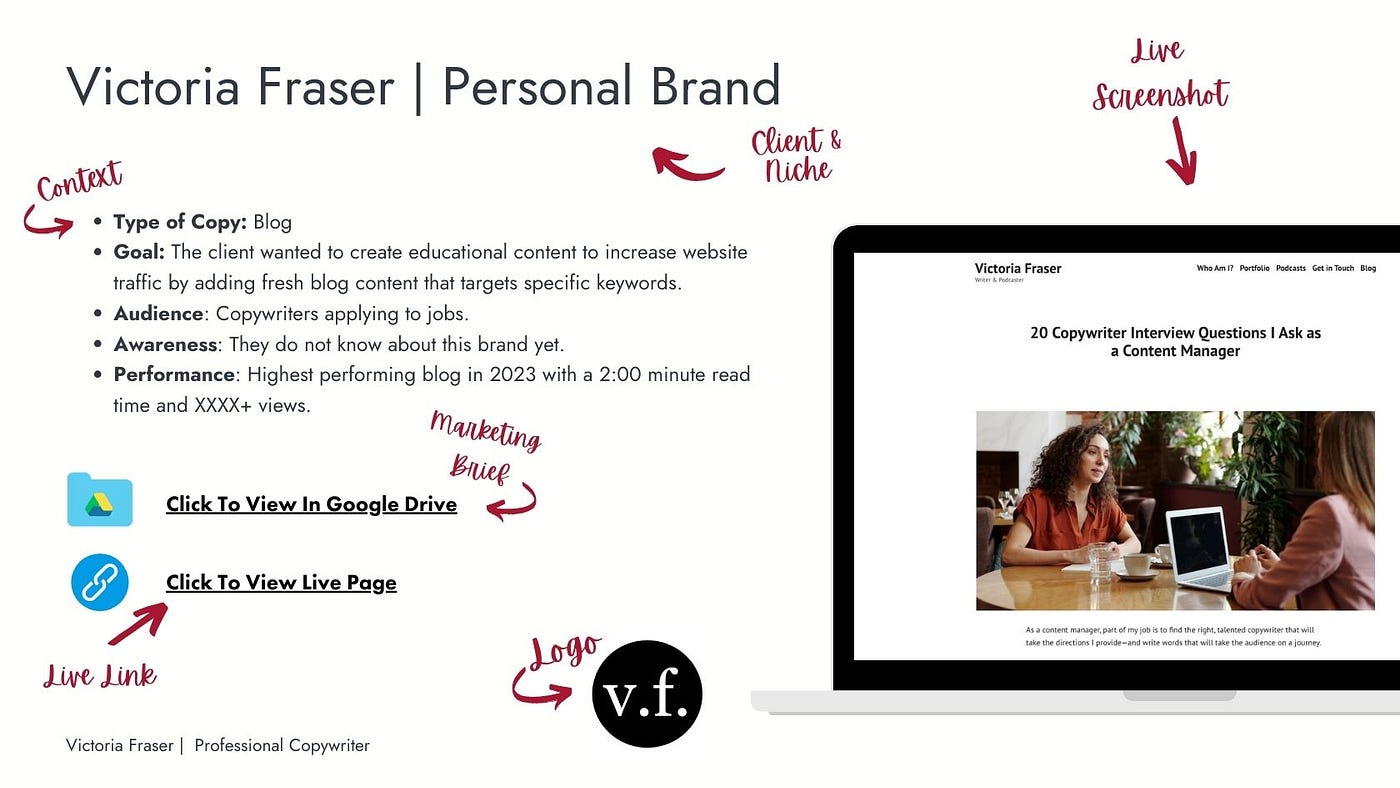
Here you can see I have the title which is composed of the Brand Name and the Niche.
Then I add the Context which shares the type of copy, goal, audience, awareness, and performance metrics. I’ve left out some details for privacy’s sake, but you can still get the idea.
Next, I share the Marketing Brief which is just a Google Drive link which takes you to a Google Doc that has the full brief and finalized copy with proper formatting.
If the copy asset is live somewhere, I like to share the link to a Live Page, but I always check it isn’t broken before I send this to a client.
Finally, I added the Logo at the bottom, as well as a Sample to show how the copy would look in a design. This is the image on the right which may be a screenshot I pulled or a simple mock-up I made (more on that later).
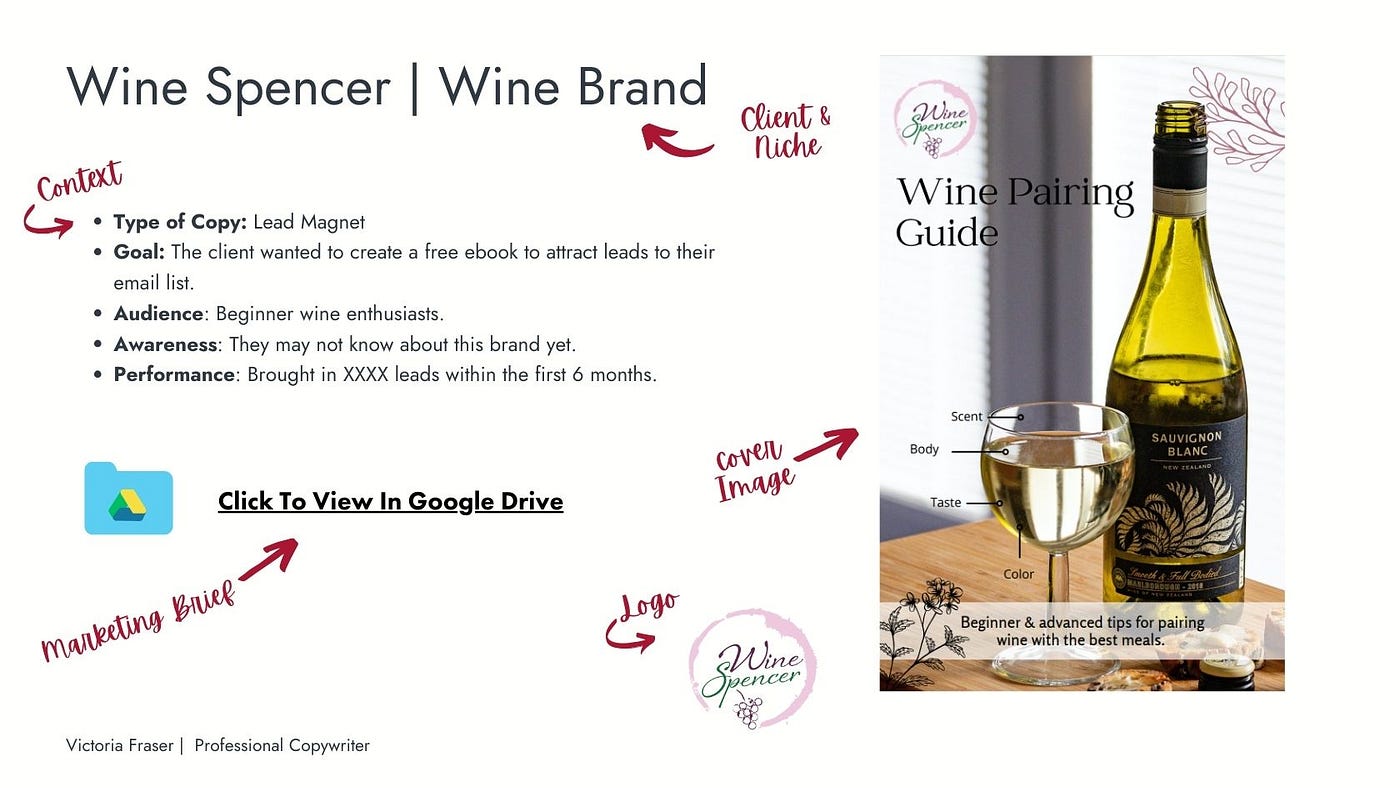
Now, here is another one for a lead magnet I did when working with a wine brand. Since the lead magnet isn’t live anywhere for me to share, I removed that link from this sample.
Otherwise, it’s almost exactly the same.
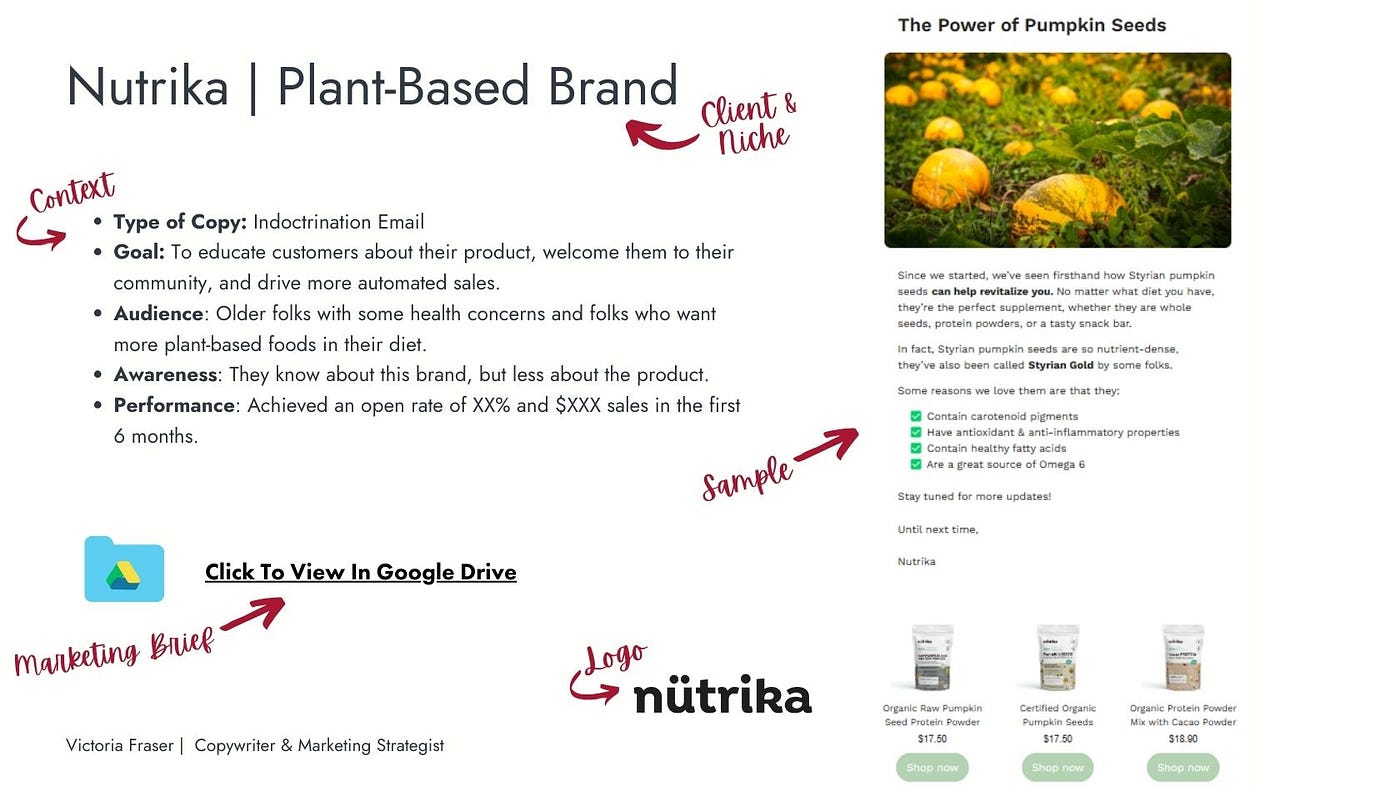
Finally, this one is an indoctrination email campaign, sometimes also called a welcome email, that I wrote for a local plant-based snack company. Again, it’s almost all the same as the previous ones.
Pro Tip: You can use tools like Canva or Ad Mockups to create a preview of what your ad copy looks like if you aren’t able to take a screenshot.
And that’s all there is to it. If you start adding even just a little bit of context to the samples in your copywriting portfolio — you’ll stand out far more than the average copywriter.
While you don’t have to include all of this, at least provide some basics. This shows a potential client that you’re not just a good writer, but also a smart marketer who thinks strategically about the WHY behind everything you write.
Now, I shockingly don’t have a blog on what goes in a marketing brief yet, but I’ll share that soon. Enjoy this little writing tutorial, and go improve those portfolios!
About the Author
Victoria Fraser is a freelance copywriter from Vancouver, Canada who works in the gaming, tech & music industry. She’s worked with global brands like the Copy Posse, Drumeo, and many more doing all things copywriting & content marketing (including making memes).
You can learn more at her website to work with her or support her writing through Buy Me a Coffee!
 Victoria Fraser
Leave a comment